

Hybrid birds carry genetic legacy from extinct species
New research has revealed that small birds from Norfolk Island in the South-West Pacific carry the genetic legacy of a now-extinct species.
The white-eyes (family Zosteropidae) are diverse group of birds that has rapidly evolved most of its 100+ species within the last two million years. For a long time, researchers thought that hybridisation (crossbreeding) between different white-eye species did not occur, but new studies are suggesting that hybridisation may have played an important role in their diversification.
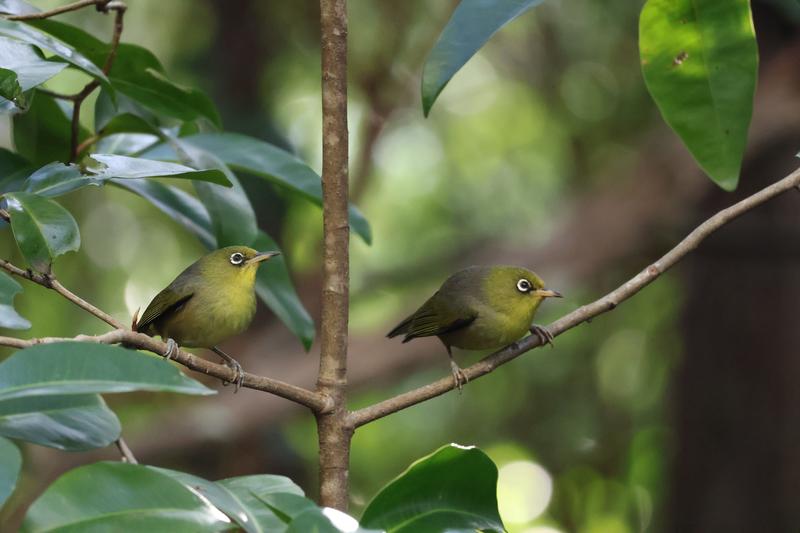
Image: Abigail Williams
Three white-eye species have existed on Norfolk Island: two island endemics, Zosterops tenuirostris and the now-extinct Z. albogularis, plus Z. lateralis, which colonised the island in 1904. Previous researchers noticed that some unusual museum specimens from the American Museum of Natural History, which were over 100 years old, looked suspiciously intermediate between two different species.
Researchers in the Department of Biology have now sequenced the DNA of the ten museum specimens as well as some field-collected blood samples. They genomically verified the identities of the hybrid specimens and showed that this crossbreeding resulted in genetic mixing between the species. Excitingly, this also revealed Z. lateralis has gained genetic material from Z. albogularis – a species of white-eye which disappeared in the 1980s – meaning that birds on Norfolk Island today carry the genetic legacy of this now-extinct lineage.
Lead researcher Abby Williams says:
“If we consider genetic diversity important in the conservation of biodiversity, then birds on Norfolk Island today are extra special because they carry DNA from a species which is no longer around. Genomic research on species that recently went extinct could also help us to understand the drivers of their extinction and help us prevent similar extinction events in future.”
Hybridisation can result in homogenisation of previously distinct forms, which has the potential to become a conservation issue, but it can also act as a catalyst for diversification through introgression and sharing of favourable genes. Z. tenuirostris is classed as Vulnerable on the IUCN Red List, but the study shows that it does not appear to be further threatened by hybridisation. In fact, if the population declines further, crossbreeding may even provide helpful additional genetic diversity to allow response to natural selection.
The researchers now plan to explore similar hybridisation events across other Pacific islands, and the potential evolutionary and conservation impacts of this hybridisation across the white-eye radiation.
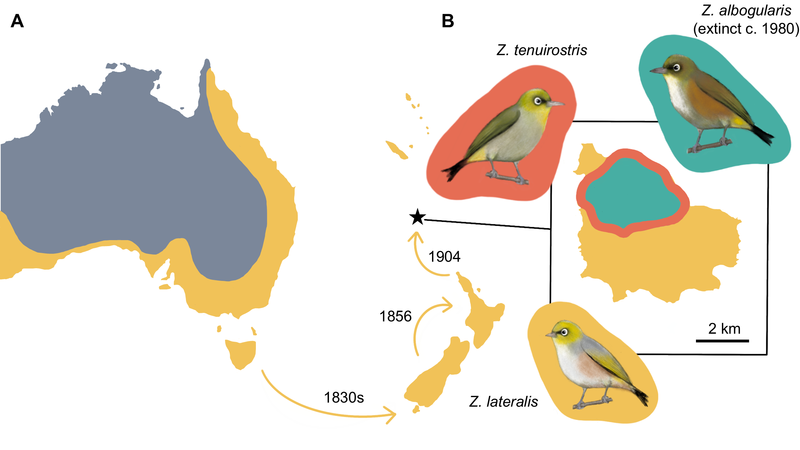
Colonisation history of Z. lateralis and current range shown in yellow. Map of Norfolk Island showing ranges; Z. lateralis has an island-wide distribution (yellow), Z. tenuirostris is found mainly in the National Park (red), as was Z. albogularis (teal) prior to extinction. Both endemics probably occurred throughout the island when it was still forested.
Image: Abby Williams
To read more about this research, published in Evolutionary Journal of the Linnean Society, visit: https://doi.org/10.1093/evolinnean/kzag028

