

Homing shearwaters don’t need magnetic sense to navigate
Long-distance navigation is no easy feat for any animal, but for some seabirds this can involve traversing hundreds of kilometres of open ocean with few obvious landmarks for guidance.
From moths to sharks, many animals are thought to navigate using the earth’s magnetic field. They use it to provide both a compass and sometimes a map to reach their distant goal. Birds aren’t an exception. Night-migratory songbirds use the inclination of the earth’s magnetic field as a compass to guide their trans-hemispheric journeys and previous research by Oxford University scientists has shown that wild seabirds — Manx shearwaters (Puffinus puffinus) — use the inclination learned at their nest site to re-find their colony after their first migration.
But other cues are also available for navigation. These include a solar compass, large scale olfactory (smell) gradients and, closer to home, a network of familiar places. So it remains unknown exactly how reliant natural navigators are on the magnetic field.
A new study reveals that even if Manx shearwaters can sense the earth’s magnetism, they do not rely on it to get home from their long foraging trips.
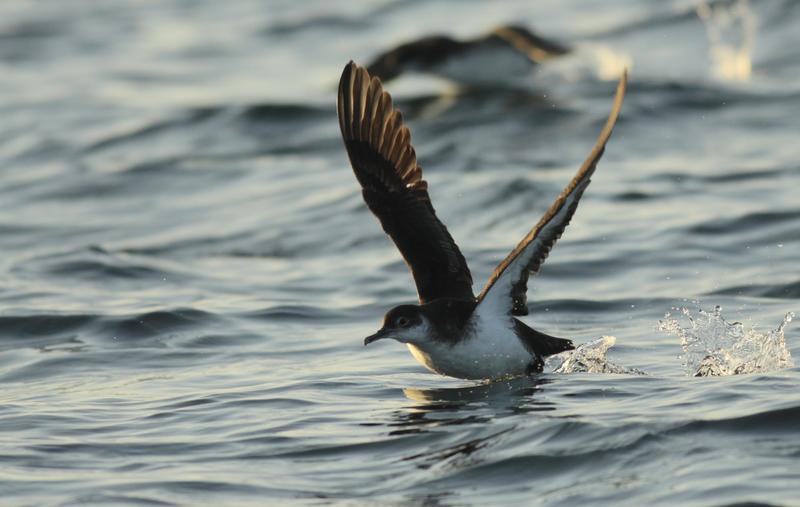
Image: Joe Wynn
In the study, researchers conducted the largest magnetic disruption experiment in wild birds to date. By attaching a magnet to the birds, they disrupted the shearwaters’ ability to use this sense to orient themselves during long-distance foraging trips. Despite this, there were no effects on either their movement, foraging success, or navigation.
Lead researcher Dr Patrick Lewin says:
“Adult shearwaters without access to magnetic information conduct their long foraging journeys on the high seas, and home straight back to their colony, without any sign of impairment. Either they do not use magnetic information to navigate, or they can switch entirely to solar and olfactory cues without any detectable loss of accuracy.”
Professor Tim Guilford, a co-author on the study, says:
“The idea of navigating by the earth's magnetic field has long captured our human imagination, and its ubiquity in birds is often now widely assumed, but here's a superb long-distance navigator that seems to be able to do without it.”
Patrick adds:
“The results show that at least some birds are capable of remarkable long-distance navigation in the absence of magnetic information. The next step is to study the factors driving differences in the navigational mechanisms of different bird groups.”
To read more about this research, published in Current Biology, visit: https://www.sciencedirect.com/science/article/pii/S0960982226010882

