

Would a whitelist work better to regulate the world’s wildlife trade?
Dr Dan Challender and Dr Amy Hinsley discuss a new paper in which they evaluate the potential of ‘reverse listing’ to regulate international wildlife trade, highlighting that this approach is not a panacea.
Globally, people use and trade at least 50,000 wild species for food, medicinal products, construction materials, and to support their livelihoods, among many other purposes. Effectively regulating this use and trade to ensure that it is legal and ecologically sustainable has long been recognised as a critical challenge to conserving biodiversity.
Currently, most wildlife laws around the world use a ‘negative list’ approach, whereby the use and trade of species on the list is either closely regulated or prohibited. However, several thousand species can be found in illegal and unsustainable trade, and for most species that are not included on the list, trade is essentially unregulated. Key challenges include a lack of knowledge of which species are in trade, delays before new species can be listed, and limited resources to effectively enforce wildlife laws.
This has prompted an increasing interest in a fundamental change in how species are legally protected: ‘reverse listing’ (also known as white-listing or positive listing). This is an approach that would see the harvest and trade in all species banned, by default, unless it can be demonstrated empirically to be ecologically sustainable.
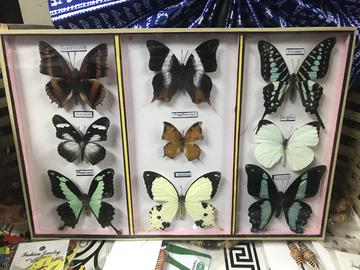
Butterfly trade in Central Africa. International trade in many butterfly species is not regulated under CITES.
Image: Dan Challender
Drawing on insights from conservation science, economics, and criminology, our new paper evaluates whether reverse listing would deliver better conservation outcomes, what challenges may arise from transitioning to a new regulatory approach, and how trade in wildlife from non-wild sources (e.g. captive breeding) would be addressed, considering potential advantages and disadvantages. We intentionally brought together a range of perspectives, including both supporters and sceptics of reverse listing, to provide a balanced assessment.
The analyses suggest that reverse listing could address some issues with the current approach to regulating wildlife trade, for instance, by providing immediate protection for species that are newly discovered and therefore not yet legally protected.
However, the findings otherwise indicate that reverse listing is unlikely to be a better solution. Simply making more harvest and trade illegal would not automatically improve law enforcement, enhance compliance with applicable laws or reduce demand for wildlife products. Effective implementation would require increased and sustained investment in law enforcement, improved systems for identifying and tracing wildlife products, and regulations that are regarded as legitimate by people subject to them. Each of these challenges applies to the current approach to regulating international wildlife trade.
Reverse listing is not a silver bullet for addressing problems with current wildlife trade regulations, including their implementation. There are no shortcuts, whether maintaining the current system or switching to reverse listing. The most effective policies will be those that are legitimate to the people subject to them and whether appropriate mechanisms are in place in enforce them. If so, then there is cause for optimism that such policies can facilitate positive outcomes for both biodiversity and people.

Many of the challenges facing effective wildlife law enforcement would likely persist under reverse listing, including deterring the illegal extraction of species from the wild.
Image: Dan Challender

Orchids for sale in the UK. Many orchids are artificially propagated, and careful consideration would be needed to determine how different production systems would be treated if countries were to adopt reverse listing.
Image: Dan Challender
To read more about this research, published in Nature Ecology & Evolution, visit: https://www.nature.com/articles/s41559-026-03161-8

