

New system developed for studying parasitic flatworms
Schistosomes are parasitic flatworms responsible for infecting hundreds of millions of people worldwide. Schistosomiasis particularly impacts those living in poverty in tropical and sub-tropical areas (World Health Organisation), leading to impaired physical and mental development particularly in children living alongside this parasite. Researchers have now established a way to develop the worms outside of a host, paving the way for more controlled studies and less reliance on host mammals while research takes place to tackle the disease.
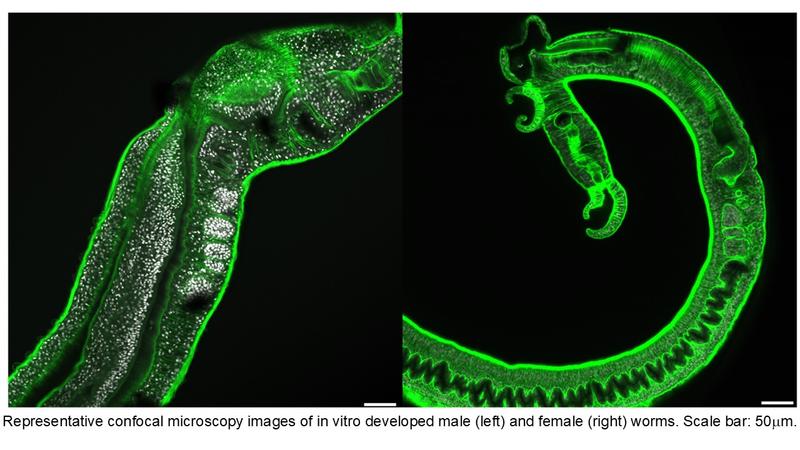
Unique among other parasitic flatworms, which are largely hermaphroditic (male and female reproductive organs in the same organism), schistosome individuals are either male or female. This unique sexual development of schistosomes takes place within mammal hosts, such as humans. Researchers wanted to optimise an approach that enables parasites to be cultured in vitro – without the need to infect animal models – through to sexual maturity.
Researchers have now established this in vitro culture system for the parasitic flatworm Schistosoma mansoni, enabling them to develop from the infective larval stage (named cercaria) into sexually dimorphic male and female worms. They found that supplementing the culture medium with human serum, rather than the commonly used foetal bovine serum, markedly enhanced parasite development and sexual maturation, ultimately enabling male-female pairing.
Lead author Dr Remi Pichon says:
“Pairing is a critical step in the Schistosoma life cycle, which promotes female sexual maturation, egg production, and subsequent life-cycle progression. Getting them to pair outside a host is tricky, and this is great progress which will help us to better investigate the processes underlying their development.”
This work provides a novel platform for investigating the fundamental biology of Schistosoma, which is a major human parasite responsible for a substantial burden of disease in endemic communities worldwide.
Senior author Dr Gabriel Rinaldi says:
“By enabling controlled studies of parasite development, sexual maturation, and host-parasite interactions in vitro, this platform could reveal previously inaccessible biological processes and identify new molecular targets for drugs, vaccines or other interventions aimed at disrupting parasite development, reproduction, and transmission.”
In the longer term, these advances could contribute to improved strategies for the control and elimination of schistosomiasis, particularly in populations where transmission remains persistent. Importantly, the platform also has the potential to make a significant contribution to the 3Rs (Replacement, Reduction and Refinement) by reducing reliance on animal models for studying intra-mammalian parasite development.
The next step will be to identify the components of human serum that support in vitro parasite development and sexual maturation. The researchers also aim to further optimise the culture conditions to support more advanced stages of development, ultimately enabling successful egg production in vitro.
To read more about this research, published in eLife, visit: https://elifesciences.org/articles/111066.

