

India’s urban coexistence crisis with 60 million street-dogs
In the most populated country in the world – and in a landscape changing with urbanisation – there is an ever-changing relationship between humans and dogs in India. Dr Nishant Kumar, India Alliance Fellow at the National Centre for Biological Sciences in India and Visiting Researcher at Oxford Biology, discusses his recent article in Nature Cities.
In South Asia, old and new collide: people raise livestock informally and feed free-ranging animals while digital economies boom. This is exemplified by the free-ranging dog crises in India.
This crisis attracted global attention on 11 Aug 2025, when the Indian Supreme Court directed authorities in Delhi and the National Capital Region (NCR) – an area encompassing approximately 4,500 km² – to capture and relocate up to 2.5 million free-ranging dogs from public spaces to (non-existent) shelters within eight weeks.
The order sought to address rising dog-bite incidents – estimated at tens of millions annually – and India’s disproportionately high rabies burden. Within 11 days, however, the court revised its directive following public protests, petitions, and logistical objection. By November 2025, the court again shifted position, mandating the removal of dogs from around 1.5 million schools, hospitals, and transport hubs while proposing campus-fencing and feeding restrictions. Subsequent hearings in January 2026 exposed deep disagreements among stakeholders and the state’s limited capacity to implement any version of the policy. This judicial volatility highlights a deeper malaise: a governance system attempting to solve an ecological problem through administrative decrees rather than systemic reforms.

Image: Salvador Campillo Alba, Getty Images
A potential angle comes in the form of collective action, starting with the demographic driver: food subsidies. Across Indian cities, dogs have access to large and often predictable quantities of food through garbage, kitchen waste and intentional feeding. These “food subsidies” affect not only how many dogs survive, but where they gather, reproduce, move and defend space.
Dogs have lived alongside people in South Asia for thousands of years. Historically, free-ranging dogs and other animals scavenged human waste and formed part of the ecological functioning of settlements. Rapid urbanisation, however, has changed this relationship. Food is increasingly concentrated at garbage points and feeding sites, while roads, buildings, walls and traffic restrict how animals move through the same landscape.
Delhi illustrates this changing ecology. Around 35 million people and an estimated 800,000 free-ranging dogs share approximately 1,500 km² of urban space. The city offers around 400,000 informal feeding and garbage points. These resources are unevenly distributed, creating places where dogs, people, vehicles and other animals repeatedly converge and negotiate coexistence, based on daily encounters, ecosystem service values, and conflicts.
Urban infrastructure itself can shape behaviour. A road may act as a corridor for one dog pack and a territorial boundary for another, while crossroads, markets, and feeding sites can increase encounters between neighbouring packs and unfamiliar people. Urban spaces are multi-use systems, based on time and space. Unlike rural areas, cities inherently have issues of countless daily interactions between people and dogs who are unfamiliar to each other.
This also means that the costs of coexistence are unevenly shared. People who regularly feed neighbourhood dogs may encounter familiar animals that are friendly towards them. Waste workers, delivery workers, cyclists, children, and others moving through the same streets at different times may experience disproportionate barking, chasing, or bite risks. The consequences of modern coexistence also extend beyond humans: free-ranging dogs can prey on wildlife, compete with native scavengers, and transmit pathogens to wild carnivores, particularly along the edges of cities and protected areas.
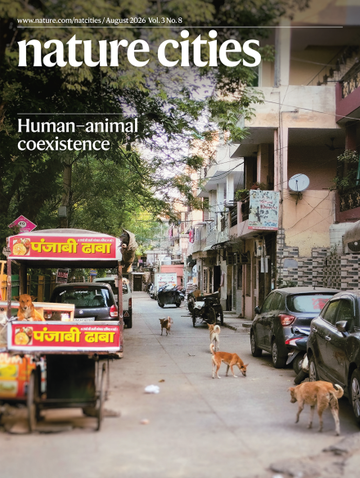
Image: Laxmi Narayan, Thinkpaws Foundation
A systemic solution could start with waste management, alongside veterinary care, public health, urban planning, and wildlife conservation working together. These actions must be supported by long-term research on dog movement, reproduction, mortality, social behaviour, and responses to changing human niche. Rather than choosing between compassion for animals and public safety, both are needed. Coexistence is not a fixed condition: it is a relationship that changes as cities, people, and animals change – and managing it requires understanding the ecology of free-ranging animals in street itself.
To read more about this research, published in Nature Cities, visit: https://www.nature.com/articles/s44284-026-00476-2

