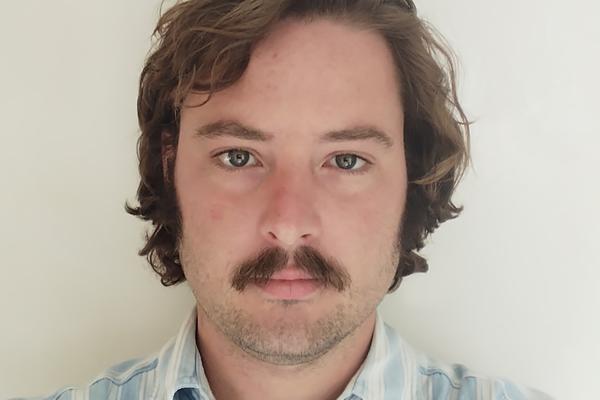

Dr Hugh Ford awarded ERC Starting Grant
The European Research Council (ERC) has awarded a Starting Grant of €1.6 million to Dr Hugh Ford for research on 3D imaging of information processing in live tissues. ERC Starting Grants are highly competitive and support cutting-edge research for early-career researchers to launch their independence. Hugh is currently a Postdoctoral Research Associate at University College London and will be joining Oxford Biology in early 2027.
Each of our tissues act almost like an individual animal – cell groups collectively sense their environment, process information and, in their own way, make the right decision. Untangling how they do this is tricky: animal tissues are complex, and it can be hard to pinpoint exactly what their information processing unit is, and less so how it works.
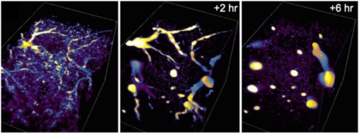
Light sheet imaging of Dictyostelium development embedded in a gel.
Image: Hugh Ford
Because of this complexity, instead of looking at animal tissues, Hugh’s research will take a different approach, using the soil-dwelling amoeba Dictyostelium. To navigate complex soil environments, Dictyostelium cells come together to form a motile tissue, called the slug. The slug effectively “sees”, “smells”, and “touches” its environment to make sophisticated migratory decisions. However, there is no sensory, nervous, or muscular system – the slug is a simple group of cells that all move like a neutrophil (a white blood cell that speeds to an injury to fight infection) and communicate like a neuron (which send excitable signals through our nervous system). Hugh aims to use this simple tissue to record and understand what it’s “thinking” while it navigates complex environments.
By live imaging tissue-wide cell signalling during Dictyostelium slug development and function, Hugh will build a Rosetta’s Stone of cell signalling patterns, detailing how their 3D shape adapts to stimuli (e.g. light) and coordinates tissue motion. This is to know how the tissue perceives, processes, and responds to environmental stimuli. To test this interpretation, Hugh will monitor how 3D patterns of cell signalling change while slugs make migratory decisions. The test will be to take live “brain” recordings to know exactly why and how a decision was made.
Through looking at a system with manageable complexity, Hugh will develop principles by which tissues process information. Ultimately, the research will establish how complex tissue behaviour emerges from conserved cell behaviours, with the aim that these principles could be used to understand information-processing in more complex animal tissues.
Hugh says:
“I am deeply grateful to the ERC for continuing to take chances on research that can be labelled as too out there or left-of-field. There’s a lot of talk about “primitive cognition” but we lack experimental tests. Maybe that’s because some ideas are so bizarre they border on unbelievable. Dictyostelium is such a beautiful organism and I hope my work will do it justice.”
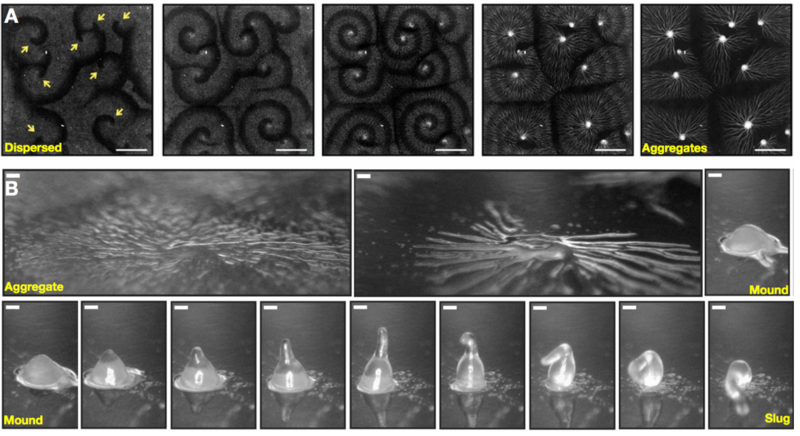
Dictyostelium development
Image: Hugh Ford