

300 years of purpletop vervain: the hidden history of a common garden plant
Professor Stephen Harris, Curator of the Oxford University Herbaria, unearths the hidden history behind a common garden plant.
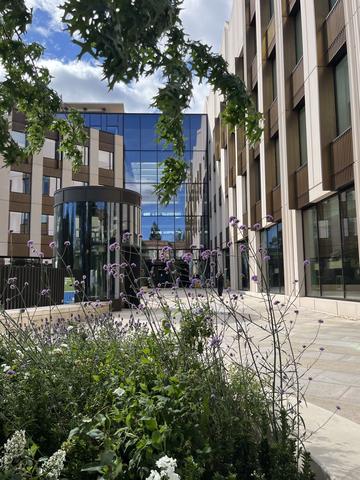
Verbena bonariensis outside the Life and Mind Building, Oxford (June 2026).
Have you ever thought of familiar garden plants’ backstories?
Currently flowering in front of the Life and Mind Building is purpletop vervain (Verbena bonariensis), a tall, square-stemmed, herbaceous perennial covered in tight, flat-topped clusters of small, fragrant, purple flowers. Purpletop vervain is popular because it is drought tolerant and attractive to pollinators.
The plant’s scientific name gives a clue to its origin – ‘from the place of good air’, i.e., Buenos Aires (Argentina). How it became part of British horticulture means delving into early-eighteenth century herbarium specimens held by Oxford University Herbaria. Three hundred years ago this year, these specimens passed through several hands on their journey to the Herbaria.
The plants were sent to Britain by John Mylam (or Milam; fl.1718-1726), and during the voyage they released seeds into the paper packets surrounding the specimens[1]. These seeds were subsequently grown by the Royal Apothecary James Sherard (1666-1738) in his garden at Eltham (Greater London) and catalogued by the German botanist Johann Dillenius (1684–1747) in his magnificently illustrated Hortus Elthamensis (1732) – one of the most important horticultural books of the eighteenth century. Dillenius became the first Sherardian professor of botany in the University of Oxford in 17372.
Mylam worked for the South Sea Company, which was founded in 17113. In 1713, during negotiations to end the War of the Spanish Succession (1701-14), the British government secured a 30-year monopoly to transport enslaved African people to the ‘Spanish Indies’ (i.e., South America and islands in the ‘South Seas’; Asiento de Negros)4. This contract, which included the right to send an annual ship loaded with tax-free goods into Spanish territories, was given to the Company. The Company reluctantly accepted – not for any moral or social concerns about the slave trade, but because it thought the trade a poor return on investment5. Nevertheless, the Company established slave trading posts across Spanish America, including Buenos Aires, along with slave depots in the Caribbean.
In remote, disease-ridden areas the Company employed physicians to oversee the health of its employees and that of unsold slaves. This is where Mylam’s role lay: in Argentina, between 1718 and 1728, these responsibilities fell on Mylam and his immediate successor Francis Hall (fl.1727-1728)6. Mylam and Hall sent 69 plant specimens from Buenos Ayres to Dillenius and his employer William Sherard (1659-1728), of which at least ten specimens produced seed cultivated for the first time in Britain at Eltham7.
Argentine botanist Arturo Erhado Burkart (1906-75) questioned Mylam’s and Hall’s fundamental interests in plants and plant collecting; they ‘were more like instruments of the great Dillenius' botanical curiosity8’. After visiting Oxford in the 1950s, Burkart recognised their collections in William Sherard’s herbarium as the largest and most significant known collection of early-eighteenth-century Argentinian plants.
We do not know either Mylam’s or Hall’s personal views about slavery. Certainly, eighteenth-century British society was reaping the rewards of trading in lives, including Dillenius and the Sherards9. Yet there were plant collectors who worked for slavers, or in slave colonies, who were bitterly opposed to slavery. For example, during their lifetimes, French botanists Jean Baptiste Christophore Fusée Aublet (1720-78; Mauritius, French Guiana and Haiti) and Michel Adanson (1727-1806; Senegal), who were employed by the Compagnie des Indes and Compagnie de Guinée, respectively, were heavily criticised for their abolitionist views10.
Next time you look at a garden plant, consider how it got there. Its route of introduction may not be as benign as it first appears.
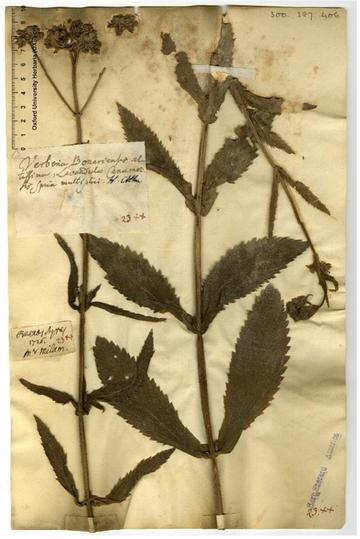
Specimen of Verbena bonariensis collected by Mylam in Buenos Aires (Argentina) in 1726. Seed was isolated from this specimen and used to raise plants in James Sherard’s celebrated garden at Eltham (Greater London). Labels in the hands of William Sherard (lower left) and Johann Dillenius (upper left) with nineteenth- and twentieth-century additions. (Hort-300-387a; Oxford University Herbaria)
1. Dillenius, JJ (1732) Hortus Elthamensis. Londini: Sumptibus auctoris, p.406. Mylam’s Verbena specimens (Hort-300-387a, Hort-300-387b, Hort-300-387c; Oxford University Herbaria). de Studer, EFS (1958) La Trata de Negros en el Rio de la Plata durante el siglo XVIII. —Buenos Aires: Universiade Buenos Aires; Craviotto, JA (1961) El doctor Juan Mylam, un botánico del siglo XVIII. Buenos Aires. Revista de Humanidades 1: 85-97.
2. Aiton, W (1789) Hortus Kewensis, or, A catalogue of the plants cultivated in the Royal Botanic Garden at Kew. Vol. 1. London: Printed for George Nicol, p.32; Dillenius, JJ (1732) Hortus Elthamensis. Londini: Sumptibus auctoris, p.406.
3. Balen, M (2002) A very English deceit: the secret history of the South Sea Bubble and the first great financial scandal. London: Fourth Estate.
4. These ‘rights’ were previously claimed by the Compagnie de Guinée et de l'Assiente du Royaume de la France. The quota in the Asiento was 4,800 ‘slave units’ annually; an adult male slave was one unit, and women and children were fractions of a unit. Slaves were supplied by a British trading company, the Royal African Company (1660-1752), operating along the West African coast.
5. Carswell, J (1960) The South Sea Bubble. London: Cresset Press.
6. Burkart, A (1963) Noticia sobre antiguos herbarios Argentinos en Gran Bretaña y su interés fitogeográfico. Darwiniana 12: 533-558.
7. Dillenius, JJ (1732) Hortus Elthamensis. Londini: Sumptibus auctoris.
8. Burkart, A (1963) Noticia sobre antiguos herbarios Argentinos en Gran Bretaña y su interés fitogeográfico. Darwiniana 12: 536. Author’s translation.
9. Delbourgo, J (2017) Collecting the world: the life and curiosity of Hans Sloane. London: Penguin Books.
10. Dover, C (1956) Aublet: the first secular abolitionist. Phylon 17: 291-95; Nicholas, J.-P. (1963) Adanson, the man. In: Lawrence, GHM (ed.) Adanson. The bicentennial of Michel Adanson’s <<Familles des plantes>>. Part One. The Hunt Botanical Library: Carnegie Institute of Technology, Pittsburgh, pp. 16-30.

