

Shifting leaves: relocating the Oxford Herbaria
Professor Stephen Harris reflects on moving the Oxford University Herbaria, which contain around 1.7 million objects, to their new home in the Life and Mind Building.
Few people have the opportunity (or should that be misfortune) to bookend their scientific career by moving a large, internationally important herbarium. More than 25 years ago I shifted Oxford University Herbaria during its refit in the Department of Plant Sciences. For the past year, I have been physically moving the Herbaria and associated collections about 100 metres from that home of some 75 years to purpose-built facilities in the Department of Biology, Life and Mind Building (LaMB). Planning for this move of approximately 1.7 million objects has taken about five years, but, as I write, the end of the task appears to be in sight.
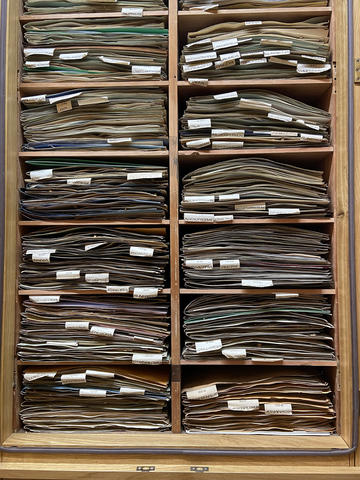
Specimens in cupboards in the old herbarium
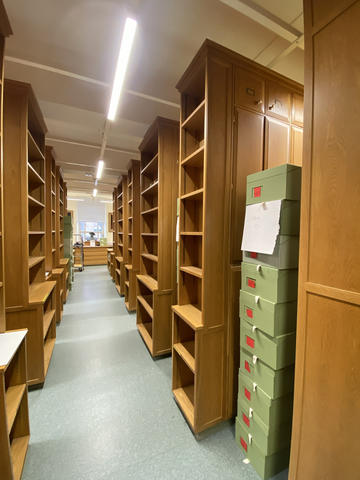
Specimens being packed up in the old herbarium
Oxford University Herbaria is a collection of botanical objects that has been amassed over the past four centuries by generations of people interested in recording global plant diversity. Beginning in the late-sixteenth century, collections in the Herbaria represent fundamental data for modern scientific botanical investigations and for understanding of our evolving relationships with the plant world. Today, such data are being used to investigate a range of current global concerns, including sustainable food production, environmental change and species conservation. Tomorrow - who knows how the Herbaria will be used and what problems will capture people’s imaginations.
The daily, at times relentless, process of packing objects and then unpacking and rehousing them has given me an opportunity to reflect on changes in the Herbaria during my three-decade-long stewardship. Perhaps the most obvious change is visibility. Formerly squirrelled away at the back of an academic department, the Herbaria now has a prominent location in the LaMB. A transformation that emphasises the Herbaria is not an artefact of a former age, but a dynamic, modern teaching and research tool contributing to a wide range of disciplines across the university. Moreover, it has a prominent role when engaging with public audiences about the fundamental importance of plant biology. Indeed, even as the Herbaria has been on the move, objects images from the collection have been central to two major exhibitions in Oxford: In Bloom at the Ashmolean Museum; and Archive Dreaming at the Schwarzman Centre.
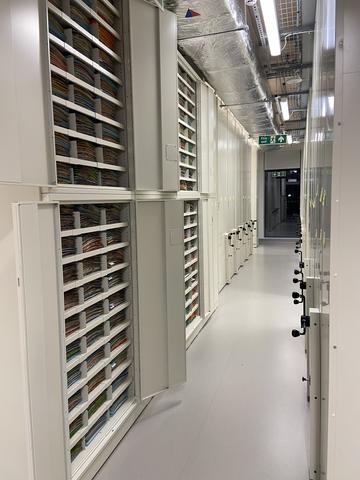
Herbaria cupboards in the LaMB
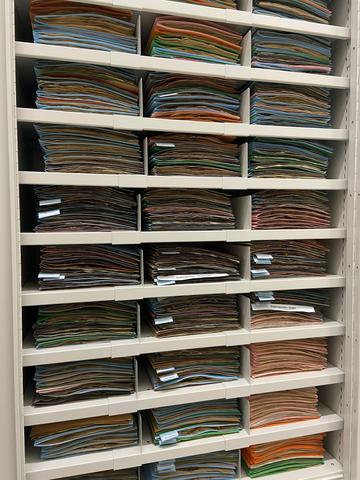
Specimens in cupboards in the LaMB
Thirty years ago, the Herbaria was primarily the territory of plant taxonomists focused on classical plant morphology and interested in describing and identifying new species, together with understanding species distributions. The advent of easily applied molecular technologies, together with computational power, meant new uses were found for the collection, including as a source of DNA for the investigation of phylogenies and species conservation. Moreover, it was also realised that herbarium specimens included other important data than just locality and date. Consequently, broad collaborations at the interfaces of disciplines have gradually emerged, especially with humanities scholars and social scientists.
More prosaically, management of the Herbaria used to be a paper-based, rather ad hoc affair. Now the collection is professionally managed using BRAHMS – software developed by researchers associated with the Herbaria. The same software is used for digitisation of the Herbaria, which has greatly increased external access to the collection. Digitisation is an on-going programme, but currently about one-third of the collection has been digitised.
Of course, there have been frustrations during the move. Not least since many of my best laid plans had to be modified in the light of practical limitations. However, one frustration has remained – even after three decades. There is simply never enough time to redetermine all the specimens I have spotted during the move that were wrongly named. I suspect this is a ‘next-life-but-one’ problem.
The move means the Herbaria can look to the future from a new home with the realisation that there is a wealth of past data available that is yet to be explored. For the first time the University’s herbarium and associated specimens are in one place, under a single management system. Moreover, once the Herbaria is fully ‘open for business’ in October, I hope people will once more let their imaginations fly as they explore the teaching and research possibilities of one of the world's great botanical collections.
To support the digitisation of the Oxford University Herbaria, visit: https://www.campaign.ox.ac.uk/mag?id=1564fab5-8dd8-4c19-bfe6-1e5666b69a15

