

Disease can shape the evolution of social life
Is disease just a cost of social life, or can it shape the evolution of social life itself?
Living in a group brings many benefits, but it also creates a problem: disease can spread more easily when individuals are in close contact. Many social insects have evolved ways to deal with this risk collectively. Ants, termites, bees, and other group-living insects may groom one another, manage waste, use antimicrobial substances, and even remove infected individuals to protect the group.
New research looks at how this kind of collective disease defence — known as social immunity — evolves.
The new study investigates many species to understand how collective disease defence might evolve. Surprisingly, the results suggest that social immunity can be both a result of cooperation and a force that promotes larger, more complex societies. Lead researcher Dr Ming Liu says:
“Disease is often seen as one of the costs of living in groups, but our work suggests it may also help shape how complex societies evolve. Once collective disease defence evolves, it may create a feedback loop: safer colonies can grow larger, and larger colonies may gain even more from collective protection.”
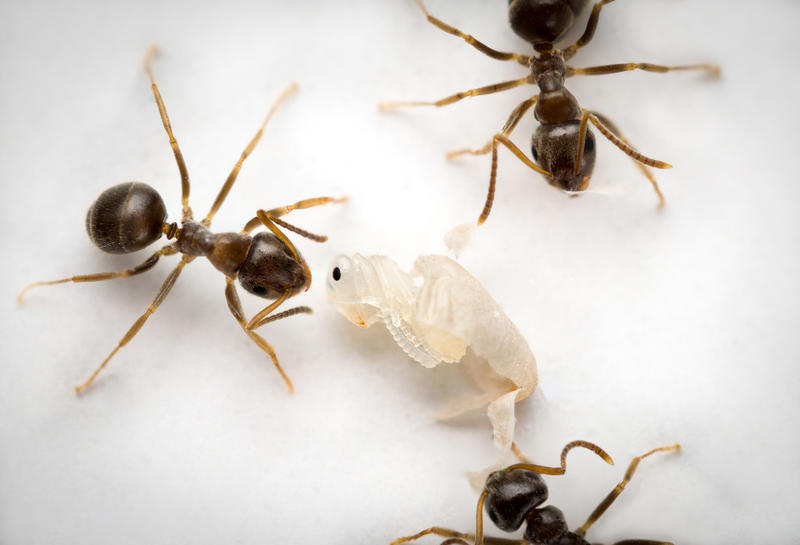
A group of Lasius ants beginning the process of 'destructive disinfection': removing the cocoon from a sick pupa, dismembering it, and spraying it with formic acid to kill both the pupa and the lethal infection it carries. This is one of the extreme forms of social immunity that we find in social insect colonies.
Image: Christopher Pull
In the study, the researchers asked two key questions. First, when does it make evolutionary sense for an individual to protect others from infection: how closely related do group members need to be for this kind of helping behaviour to evolve? Second, what happens after this collective defence evolves: does it simply reduce disease, or can it also change the way colonies grow and reproduce?
This combined approach allowed them to ask not only when social immunity can first evolve, but also what evolutionary changes might follow once it is in place. The results suggest that social immunity can first evolve even in relatively simple social systems if the benefits of protecting others from disease are high enough.
Once it is in place, collective disease defence can reduce the risk that a colony dies from infection. This can make it worthwhile for colonies to spend longer growing before they reproduce, leading to larger colonies.
Larger colonies may then gain even more, with more individuals to protect and potentially more opportunities for disease to spread. This is a possible feedback loop which could then favour more specialised roles among group members. In short, disease may not just be a cost of social life, it may also help shape social complexity. Coauthor Professor Stuart West says:
“Just like crowded human societies, a colony of social insects can be especially susceptible to pathogens. Social insects have evolved a diversity of ways to deal with this problem, by treating or even removing infected individuals. Our models suggest that these behaviours facilitate the evolution of larger and more complex societies.”
The study demonstrates how disease can act as an ecological and evolutionary force, not only as a medical problem. It highlights the other side of disease: collective disease defence can evolve through cooperation and may then influence how social groups grow, reproduce, and divide labour.
Different species may use very different forms of defence, from grooming to waste management to antimicrobial substances, but this study now provides a way to compare these behaviours via the same underlying questions: what are the costs and benefits, who receives those benefits, and how does disease defence affect the future evolution of the group?
The researchers now plan to turn this theoretical framework into testable biological questions, for example to measure how social immunity affects survival, growth, and reproduction under different disease pressures.
In parallel, they are interested in developing more detailed models for specific groups of organisms, including seasonal breeding, different worker roles, specific forms of pathogen transmission, or division of labour over disease defence itself.
To read more about this research, published in PNAS, visit: https://www.pnas.org/doi/10.1073/pnas.2518957123

