

Infection Genetics
About
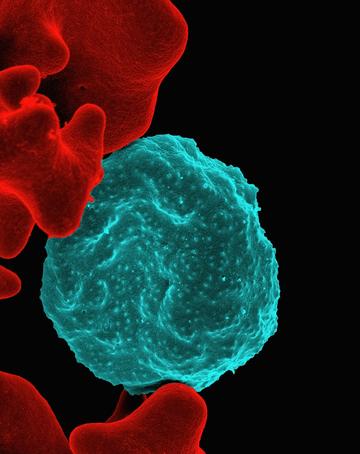
Colourised scanning electron micrograph of a red blood cell infected with malaria parasites (teal) alongside uninfected cells (red)
Image: National Institute of Allergy and Infectious Diseases
Why can infection with the same pathogen lead to very different outcomes in different hosts? Part of the answer lies in host genetics. The co-evolutionary battle between hosts and their pathogens generates and maintains huge genetic diversity at specific places in both host and pathogen genomes. We study this process using mathematical and computational approaches to simulate evolution. Particular areas of interest include how humans and other primates have adapted to malaria, and the evolution of the genes of vertebrate immune systems.
Current projects include:
- Predicting infectious disease evolution in light of immune system diversity (for which we gratefully acknowledge funding from an Academy of Medical Sciences Springboard Grant).
- Understanding how balancing selection shapes Killer-cell Immunoglobulin-like Receptor (KIR) evolution.
- Understanding how host immune memory impacts the evolution of infection blocking mutations.
People
Publications
News

