

Indonesia’s first vessel buyout permanently retires shark fishing boats in East Lombok
Dr Hollie Booth discusses a new initiative, believed to be the first vessel buyout scheme in Indonesia: two shark longline fishing vessels have been permanently retired from one of the country’s most prominent shark fisheries, through a collaborative research-to-impact project between local NGO Kebersamaan Untuk Lautan (KUL) and researchers at Bangor University, University of Oxford and IPB University.
Why Tanjung Luar matters
Tanjung Luar, on the coast of East Lombok, is home to around 61 licensed shark longline vessels. Over a two-year monitoring period, more than 13,000 sharks and rays from 57 species were recorded in the catch – with more than 90% comprising species now listed under the Convention on International Trade in Endangered Species (CITES). As international trade regulations on sharks continue to tighten, the long-term viability of targeted shark fishing is increasingly uncertain. As such, the Tanjung Luar shark fishery represents a risk for threatened species, CITES compliance and the 150 fisher households who depend directly on this fishery for their livelihoods.
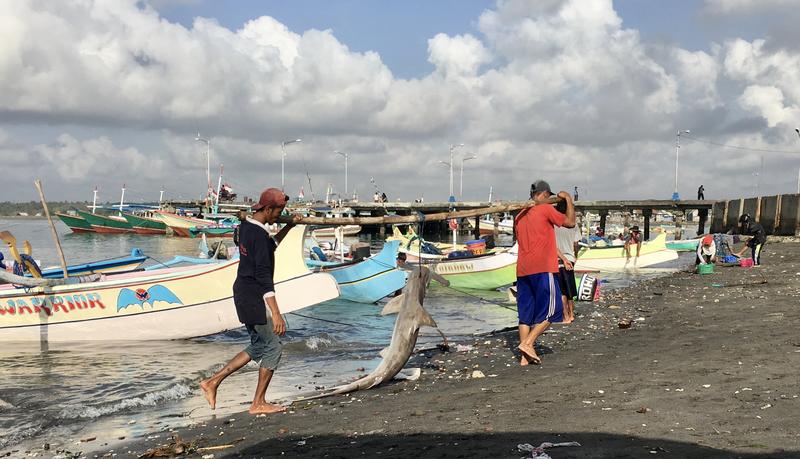
Image: Hollie Booth
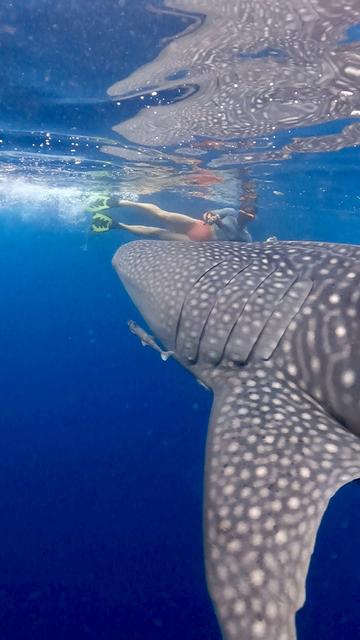
Image: Hollie Booth
This matters beyond the fishery itself. West Nusa Tenggara’s waters contain several internationally recognised Important Shark and Ray Areas (ISRAs), and the province is a growing hub for marine tourism: sites like The Magnet (known for manta rays and hammerhead aggregations), Saleh Bay (whale shark encounters) and Gili Petelu (reef shark snorkelling) draw visitors from around the world. Research suggests that millions of dollars per year in tourism revenue can be attributed to healthy shark and ray populations in Indonesia. Protecting these species is not just a conservation priority – it is an investment in the province’s blue economy.
A novel approach: the incentive-compatible auction
My research focuses on developing practical, evidence-based tools for reconciling conservation goals with the livelihoods and wellbeing of coastal communities. The vessel buyout program is a direct application of this work.
Implemented by KUL in partnership with the Department of Marine Affaris and Fisheries of West Nusa Tenggara (DKP NTB), we used an incentive-compatible sealed-bid reverse auction in which vessel owners who voluntarily wished to exit the fishery submitted confidential bids stating the minimum price they would accept. The lowest bidders were selected, based on the available budget, and all winners were paid a uniform price set at the level of the highest rejected bid. This ‘second-price’ rule encourages honest bidding, maximises the number of vessels retired for a given budget, and ensures a transparent and fair process. To our knowledge, this is the first times such a mechanism has been applied in a small-scale tropical fishery and for the purposes of shark conservation.
Results: fair and cost-effective conservation
Four vessel owners voluntarily submitted bids. Based on KUL’s available budget, two were selected and each paid IDR 300 million (~US$17,700). A formal handover ceremony was held at Tanjung Luar Fishing Port together with DKP NTB, including the signing of binding agreements and the surrender of all vessel documentation and fishing licences. DKP NTB are now overseeing the permanent decommissioning of the vessels and cancellation of permits.
Based on catch monitoring data, the two retired vessels together landed 406 sharks and rays in 2025 alone. Over a ten-year horizon, their permanent removal could prevent an estimated 4,000 or more sharks and rays being killed, at a cost of less than US$9 per animal saved – comparing favourably with alternative approaches and with the estimated tourism value of living sharks.
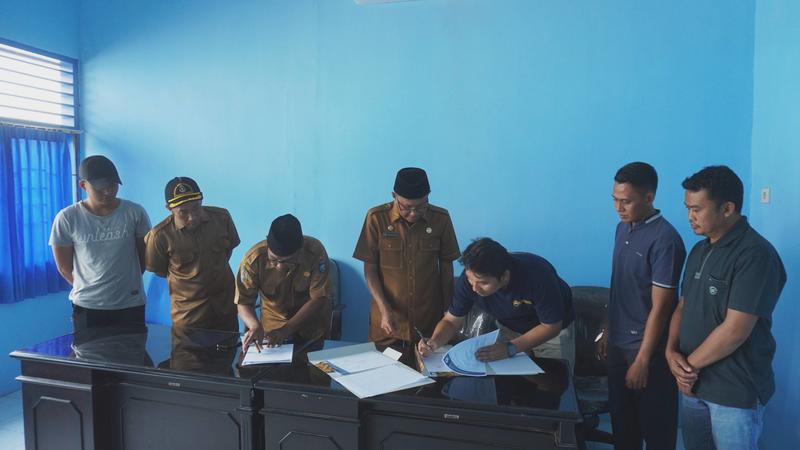
Image: Kebersamaan Untuk Lautan
M. Said Ramdlan, co-founder and secretary of KUL, said: “This program shows that fishers are willing to voluntarily exit the shark fishery when they are offered a fair price and a respectful process. We designed this together with the fishing community, and the response gives us confidence that this approach can be scaled up.”
Muslim, S.T, M.Si, of DKP NTB, said: “We appreciate the program implemented by KUL, as it provides opportunities for shark fishers in Tanjung Luar who wish to transition to alternative livelihoods, while still addressing conservation targets and the welfare of fishers. This initiative is aligned with the Regional Medium-Term Development Plan (RPJMD) of West Nusa Tenggara Province.”
Part of a wider collaboration
The vessel buyout pilot is part of a wider program of collaborative research and conservation action that I lead from Bangor University, working with Prof Julia Jones in the School of Environmental and Natural Sciences. Through our grants from the International Science Partnerships Fund (ISPF) and the Shark Conservation Fund (SCF), we are supporting KUL and partners across Indonesia to develop and evaluate community-based approaches to shark and ray conservation – from deploying underwater camera systems (BRUVS) with fishers in Aceh, to designing incentive-based interventions and supporting government partners with CITES implementation.
In NTB specifically, KUL has recently been appointed as the coordinator for shark and ray fisheries management under the province’s new Joint Fisheries Management Committee (KPBP), formalised through a Decree of the Governor. This growing institutional partnership is a testament to the trust and credibility that KUL has built through years of working alongside fishing communities and government and provides a platform for scaling up the evidence-based approaches we are developing together.
As Indonesia works to meet its CITES obligations for sharks and rays, there is a growing need for practical mechanisms to reduce fishing pressure that are fair to the communities who depend on these fisheries. This pilot demonstrates that vessel buyouts, done right, offer one such approach – and provides a replicable model that could be scaled up as part of a broader, government-led transition towards sustainable shark fisheries management in Indonesia.
This work was supported by the UK Darwin Initiative via the University of Oxford, the International Science Partnerships Fund (ISPF) and the Shark Conservation Fund via Bangor University, and a direct grant to KUL from the Oceanic Society.

