

The hidden cost of sperm storage: ejaculates found to deteriorate across the animal kingdom
Current World Health Organisation (WHO) guidelines typically recommend 2–7 days of abstinence before taking semen samples or assisted reproduction. However, a new study suggests that regular ejaculation – whether through sexual activity or masturbation – results in higher quality sperm, with less DNA damage.
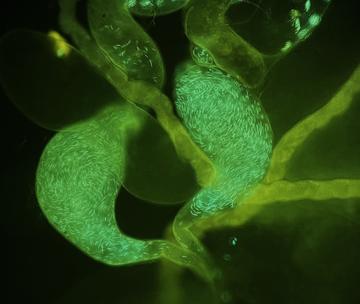
Sperm tagged with Green fluorescent protein in the testes and seminal vesicles (male sperm storage organs) of a male Drosophila fruit fly.
Image: Krish Sanghvi
The findings are based on a major, cross-species analysis which revealed a shared pattern across many animals, from insects to mammals. Sperm that is stored (whether in males or females) deteriorates rapidly – resulting in reduced sperm performance, fertilisation success, and embryo quality. Crucially, the new study also offers insights into why this happens.
The researchers carried out a meta-analysis of 115 human studies (involving 54,889 men) and 56 studies across 30 non-human species. This confirmed that mature sperm in storage generally deteriorates in quality independently of the age of the male – a process called post-meiotic sperm senescence.
In humans, longer periods of sexual abstinence were associated with increased sperm DNA damage and oxidative stress, along with reduced sperm motility and viability.
Co-lead author Dr Rebecca Dean said:
"Because sperm are highly mobile and have minimal cytoplasm, they quickly exhaust their stored energy reserves and have limited capacity for repair. This makes storage particularly damaging compared to other types of cells. Our study highlights how regular ejaculation can provide a small but meaningful boost to male fertility."
Differences between males and females
Both male and female animals can store sperm as a reproductive strategy (in humans, sperm can last for several days in females but the effects of such storage are unknown). In males this ensures enough sperm are present for mating, and in females this can enable reproduction even when males are scarce. However, the study found a striking difference in the rate of sperm deterioration in males versus females. In the species studied, females are generally better than males at preserving sperm quality long-term.
"This likely reflects the evolution of female-specific adaptations, such as specialised storage organs that provide antioxidants to extend sperm viability", explained senior author Dr Irem Sepil. "These organs often secrete reproductive fluids to nourish sperm and could provide unexplored avenues for biomimicking technology to improve artificial sperm storage in the future."
Lead author Dr Krish Sanghvi added:
"Ejaculates should be viewed as populations of individual sperm which undergo birth, death, ageing and selective mortality. The rates of these demographic processes can differ in males and females, mediating the ‘demographic’ structure of sperm populations and sex-specific differences in sperm storage effects."
Implications for human fertility
That sperm can age in both sexes independently of the organism’s age has been largely ignored in reproductive medicine. The findings therefore have immediate implications for clinical practice. For instance, the results suggest that the upper limit of seven days in the WHO guidelines may be too long. This aligns with recent evidence suggesting that ejaculating within 48 hours of providing a sample can significantly improve IVF outcomes.
By breaking down the barriers between biomedical and zoological research, this study provides a new lens for understanding reproduction. Besides influencing protocols in fertility clinics and assisted reproduction, the findings could also benefit captive breeding programmes for endangered species - as well as deepening our understanding of how species evolved mechanisms to reduce sperm damage during storage.
To read more about this research, published in Proceedings of the Royal Society B, visit: https://doi.org/10.1098/rspb.2025.3181

