

The science behind communication in interspecies cooperation
Katie Dunkley, a BBSRC Research Fellow, investigates how communication enables cooperation between animals. In a new review paper published in Animal Behaviour, she brings together an impressive team of 57 co-authors from across disciplines.
This blog highlights the work of several co-authors involved in this paper - Katie, Eliupendo Laltaika, Leela Channer, and Alexandre Machado - who all aim to understand how different animal species ‘talk’ to each other to make cooperation work.
Across the natural world, there are many fascinating ways in which animals, including humans, work together.
In our new review paper, we examine how the exchange of information helps facilitate cooperation between different animal species. The paper grew out of an interdisciplinary workshop on interspecies cooperation held in Cambridge in June 2023, where researchers, conservationists and human-wildlife cooperation practitioners studying a wide variety of animal systems came together. Together, the group explored how cues and signals, whether visual, acoustic, or behavioural, help align the interests of entirely different species, enabling cooperative partnerships to emerge and persist.
Katie says:
“It was a real pleasure to work with and learn from such a diverse group of people studying animal cooperation at different career stages for this review. Each person brought unique perspectives and insights, helping to connect ideas across disciplines. It was an invaluable experience.”
Cleaner and client fish
Katie’s own work focuses on cleaning interactions between fish. Small ‘cleaner’ fish eat parasites of the bodies of much larger client fish: clients health can benefit whilst cleaners gain food, a win–win exchange, but only if both sides play by the rules. Cleaners can exploit, and harm clients instead by biting off extra food for themselves, such as scales.
Her research investigates the signals that keep this relationship on track, from how interactions are initiated to how partners coordinate and avoid conflict. Similar cleaning partnerships exist on land too, such as the relationship between oxpecker birds and buffalo.
Katie notes:
“Studying how information flows between species gives us a powerful window into how communication systems originate, change, and sometimes coevolve.”
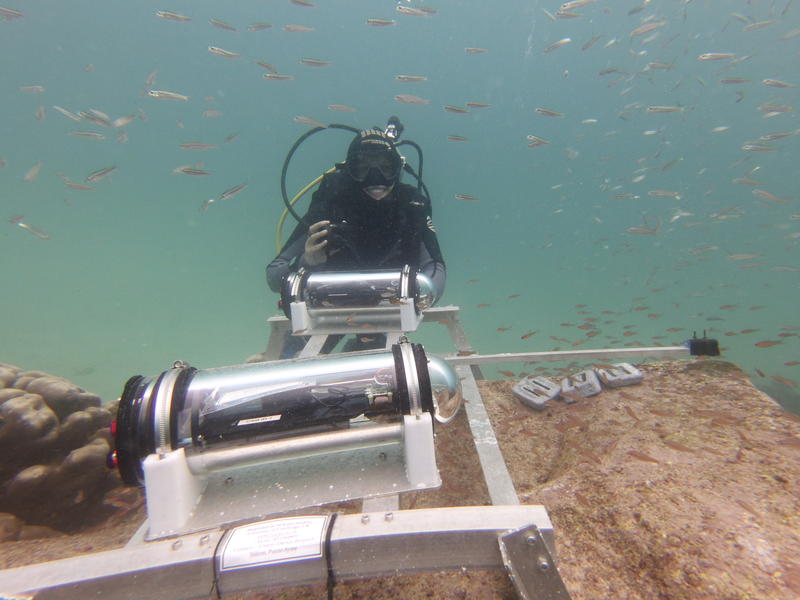
Lead author Katie Dunkley setting up her long-term camera in the Galapagos to record cleaner-client interactions.
Image: Wilson Iñiguez
Humans and birds
One of the other co-authors is Eliupendo Laltaika, a conservationist and PhD researcher with the Honeyguide Research Project in Tanzania. His work focuses on the cooperation between greater honeyguide birds (Indicator indicator) and human honey-hunters in Tanzania.
“I’ve just returned from fieldwork interviewing honey-hunters from different cultures and documenting the diverse specialised calls they use to communicate with honeyguides,” he explains. “It reminded me of my childhood in northern Tanzania, when I honey-hunted with honeyguides together with my brother.”
This human–bird partnership, found across several regions of Africa, relies on a sophisticated exchange of signals. Honeyguides use a distinctive call to attract human partners and lead them to bees’ nests, while people respond with culturally specific calls that the birds appear to recognise and learn.
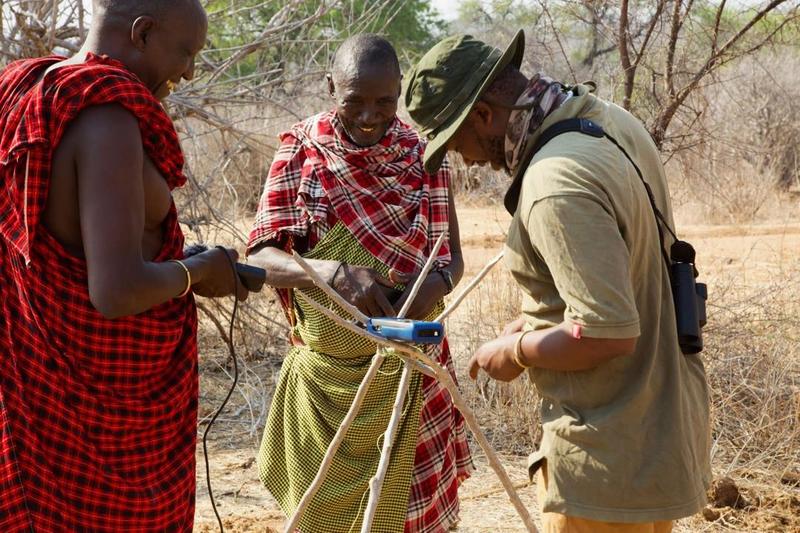
Co-author Eliupendo Laltaika (right) prepares field equipment ahead of a playback experiment, working alongside Mboyo Masiaya (left) and Lelia Olapi (centre), two field assistants from the Ndorobo community.
Image: Adair Dammann
Warthogs and mongooses
In other parts of Africa, cooperation between species manifests in different ways. In some populations, common warthogs (Phacochoerus africanus) adopt specific postures, kneeling and lying down to solicit tick removal from banded mongooses (Mungos mungo), which in turn benefit from this food source. Co-author Leela Channer is a PhD researcher with the University of Exeter at the Banded Mongoose Research Project in Uganda, studying this mutualistic cleaning relationship:
“It looks like the postures that the warthogs use to signal to the mongooses are the same as those used to request grooming from other warthogs. This suggests that warthogs have co-opted signals which they use for grooming an intraspecific context and applied them to a similar context with another species.”
Intriguingly, these body postures somewhat mimic the angled head or tail-standing body orientations that client fish use to invite cleaning interactions from cleaner fishes, and Katie is looking into these poses in parallel whilst at Oxford.
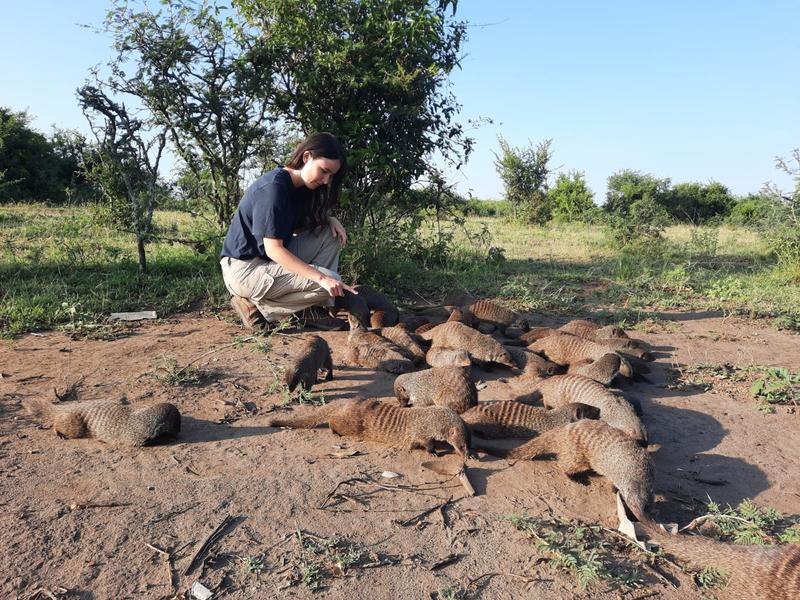
Co-author Leela Channer alongside a group of banded mongooses in Queen Elizabeth National Park, Uganda.
Image: Laura LaBarge
Humans and dolphins
In a different part of the globe, co-author Alexandre Machado is a postdoctoral researcher with the Aquatic Mammals Laboratory at Universidade Federal de Santa Catarina in Brazil, investigating the cooperative interactions between artisanal fishers and Lahille’s bottlenose dolphins (Tursiops truncatus gephyreus) in southern Brazil. Here, fishers interpret dolphin behaviours like back-arching dives and tail-slaps as indicators of when to cast their nets, and both then gain an increased catch.
"My research focuses on how humans and dolphins synchronise their behaviour to catch fish, and how individual differences and social dynamics shape this rare mutualism. I have been doing fieldwork in Laguna for nearly ten years, and I am still fascinated by the close relationship fishers have with the dolphins: they recognise individual dolphins, and rely on specific visual cues of certain foraging dolphins to know when to cast their nets. Not all dolphins in the population regularly cooperate with humans, and some may be better partners than others, so fishers pay close attention to who they are working with.”

Co-author Alexandre Machado (right) stands beside a fisherman as he waits for cues from cooperating dolphins before casting his net.
Image: Analice Pereira
A cross-species approach
This review has ultimately brought together researchers studying similar interactions across a wide range of taxa, allowing us to draw on their similarities and contrasts to understand more about how the animals have adapted and learnt to communicate and cooperate across species boundaries.
Looking ahead, the field offers many exciting opportunities. More experimental work and broader comparative research across taxa will be crucial for understanding how interspecies communication emerge, persist, and shape cooperation between animal species.

