

Spiders’ form and posture help to dampen noise as they sense vibrations
Vibrations are everywhere. From feet stomps to wing flaps, from wind blows to ground shakes, many things generate vibrations through our environment – and these convey crucial information about what’s around us.
But all animals that sense vibrations face a common problem: separating important information from noise. Even body movements can generate noise, and these can obscure small vibrations that travel along the ground or webs. Now, new research has revealed that body form and posture help filter vibration information before it reaches some of spiders’ most important sensors.
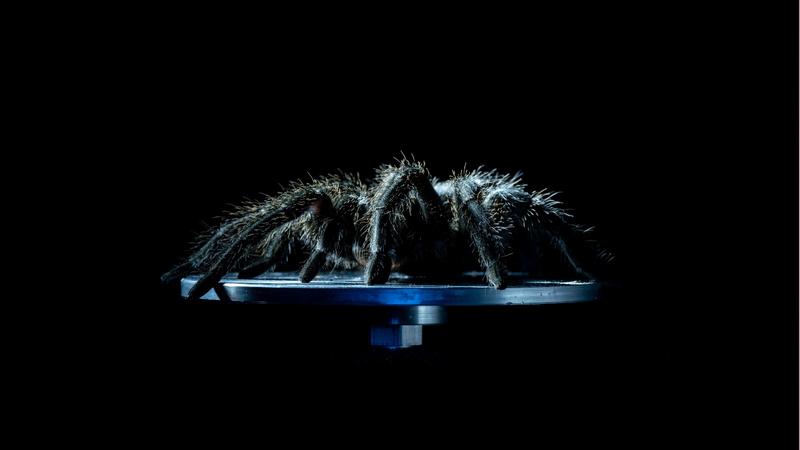
Spiders can detect vibrations from the environment, giving them information about what is around.
Image: Thomas Miller
Humans might notice vibrations from an earthquake, but we don’t always notice smaller vibrations that happen every day. Spiders, however, are keenly perceptive – it’s an ancient skill used to communicate with each other, avoid predators, and detect prey. Spider webs are an extension of this skill, with vibrations travelling through the web to where they lie in wait.
Tracking 50 points across a tarantula’s (Grammostola pulchra) body, researchers recorded how it vibrated as it stood on a platform. From this, they calculated how vibrations were transmitted through the body.
They found that large motions in the central, heaviest part of the spider body (the cephalothorax and abdomen) were diminished before reaching the sensors in the tips of their legs – thought to be particularly important for sensing incoming vibrations from the ground. This feature of a spider’s body increases the relative signal strength for vibrations like cues from prey, or courtship vibrations from other tarantulas.
Lead researcher Dr Thomas Miller says:
“We compared our results to what has been reported for other arthropods. Surprisingly, we didn’t find much evidence for resonance at the locations around the sensors being useful for vibration sensing in tarantulas, which was unexpected, as this is used adaptively by many other arthropods such as bees to amplify incoming vibrations.”
The results suggest that posture alterations can help dampen noise from the abdomen and cephalothorax, decreasing the vibrations that make it to the key external sensors at the ends of spiders’ legs: the legs move flexibly, separating motion of the abdomen and cephalothorax from the leg tips. This means spiders can ‘listen in’ to subtle ground and web vibrations without these signals being masked by the overriding ‘ringing bell’ of body resonance.
The research has potential applications in sensor engineering, and the data are already being used to develop bioinspired algorithms for locating vibration sources.
The team plan to continue this work by looking at more species of spider, and by developing their measurement techniques to capture vibration data in 3 dimensions using high-speed macro video.
To read more about this research, published in Proceedings B, visit: https://doi.org/10.1098/rspb.2026.0915

