

Running like the Red Queen: birds tracking climate change
In Through the Looking-Glass by Lewis Carroll, the Red Queen famously says to Alice: “Now, here, you see, it takes all the running you can do, to keep in the same place.” A new study by University of Oxford researchers shows that, for one of our common birds, their response to climate change over six decades has much in common with the Red Queen. The long-term study of Great Tits at Wytham Woods near Oxford shows that the birds have shifted their breeding times forwards by more than two weeks. But by doing so, they have stayed in the same place with respect to the temperature at which they breed, despite 2˚C of local warming over this time.
For decades, scientists have tracked the impacts of climate change using human calendars, marking earlier springs, shifting breeding dates, and delayed migrations. But nature doesn’t operate on fixed dates, and relying on them can obscure what really matters: the environmental conditions organisms experience and which drive their responses.
Here, researchers have used six decades worth of individual-based data from wild great tits (Parus major), alongside 45 years of data on the winter moth (Operophtera brumata), collected from Wytham Woods, an iconic location that has been the subject of continuous ecological research programmes since 1947. Analysing more than 12,000 breeding attempts between 1965 and 2023, they found that great tits now breed 16.5 days earlier than they did in the 1960s. This shift has enabled the birds to maintain stable thermal conditions during reproduction, effectively buffering the impact of a warming climate.
Dr López-Idiáquez reflects on the value of long-term ecological data:
“Long-term datasets like this are incredibly valuable, revealing patterns and insights that would otherwise remain hidden, and provide answers to questions the founders of these studies would have never considered. The research here was made possible by the hundreds of fieldworkers, PhD students and postdocs who have monitored the great tit population in Wytham Woods over decades.”
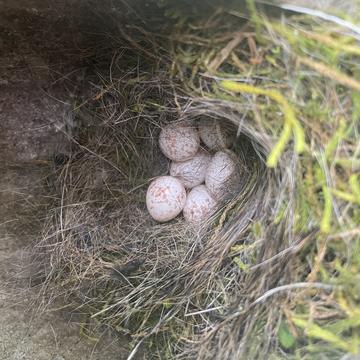
Image: David Lopez Idiaquez
Instead of sticking to the same dates each year, great tits time their egg laying to match the conditions that give their chicks the best chance of survival. It is well-known that great tits in Wytham, as in other populations across Europe, have shifted their breeding timing because of climate change. Previously, research exploring this question have analysed these shifts in timing (or phenology) using calendar dates. However, dates reveal very little about the reasons behind these shifts. In the new work, the researchers argue that measuring change relative to relevant environmental gradients offers new insight into the causes of climate-driven changes in timing. For example, as in this study, considering the actual temperatures experienced during breeding, is relevant as they can have direct and indirect impacts on reproductive success and survival.
In the new study, the researchers show that temperatures experienced by females when laying their eggs are closely tied to food availability. Those females breeding at intermediate temperatures achieve the highest synchrony with the peak abundance of winter moth caterpillars, a key food source that can make up more than 80% of nestlings’ diet. This provides a mechanistic explanation for the reported temperature tracking, as those females breeding at higher and lower temperatures experience a reduced reproductive success.
“Shifting our perspective to analysing phenological changes relative to environmental gradients, rather than calendar dates has the potential to shed new light, by establishing direct links with biologically relevant variables,”
said Professor Ben Sheldon, who leads the long-term study of birds in Wytham, explaining that,
“For example, understanding how key environmental variables during breeding, such as temperature, precipitation or the frequency of extreme climatic events, change over time can shed light on the likely consequences of the phenological shifts we see in nature”.
To read more about this research, published in Science Advances, visit: https://www.science.org/doi/full/10.1126/sciadv.aeg5926

