

Pollution and warming can both amplify and offset the other’s impacts at coasts
Marine coastal zones are valuable but vulnerable ecosystems. The ‘Blue Economy’ – economic interests that are tied to the marine environment – is not only something that depends on healthy seas, but is also a source of pressure, from shipping and aquaculture to coastal development and offshore energy.
Coastal ecosystems are also shaped by both global drivers like warming and local pressures like sewage pollution, eutrophication, habitat change, and growing human use. These pressures do not occur in isolation, and new research reveals a complex dynamic: they can either amplify or offset each other, creating outcomes that can be greater than, or less than, the simple sum of their parts.
The researchers tracked ecological change across multiple biological scales — from functional groups and population patterns to diet and gene expression — to better understand how both single and combined stressors can influence coastal ecosystems and the management decisions built around them. By investigating the combination of warming and sewage-associated nutrient pollution, the study revealed that these interactions can shift through time, with sewage pollution sometimes overwhelming or altering the effects of warming. Different functional groups responded in different ways, with warming suppressing some macroalgae and barnacle populations, while pollution generally increased the abundance of several intertidal organisms.
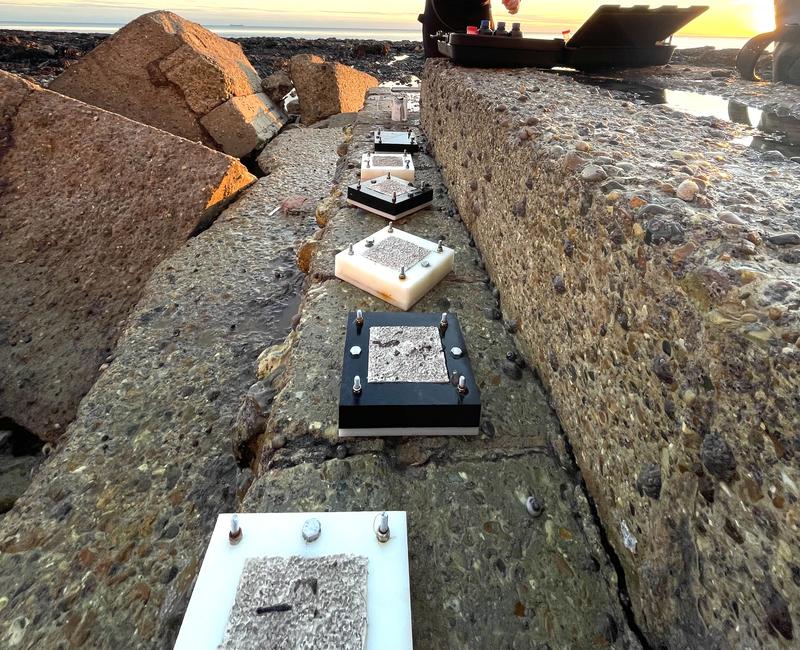
During the study, black and white sensors heated differently were placed at different distances to pollution sources.
Image: Ramesh Wilson
For example, while cyanobacteria were already more common at polluted sites, warming intensified these increases when both stressors occurred together, producing higher-than-expected levels. High levels of cyanobacteria – called ‘algal blooms’ – can be harmful to human and animal health, and can diminish the light and oxygen available in water for species like fish or plants.
The researchers also found that barnacle populations changed in consistent and visible ways under warming and sewage pollution, suggesting they could act as practical indicators of changing intertidal environmental conditions. Polluted sites generally supported more and larger barnacles, while warming reduced their abundance, showing how common shoreline species may help reveal the combined impacts of multiple coastal stressors. The researchers also discovered that barnacles were incorporating sewage-derived nitrogen and carbon into their tissues, showing how pollution can move through coastal food webs. Under warming conditions, barnacle tissues also shifted toward more carbon-rich compounds, a pattern consistent with physiological stress and altered energy balance during prolonged heat exposure.
The researchers then developed a framework for more adaptive and interaction-aware planning, to allow these findings to be realistically translated into management. This includes both foundational components such as stronger research and operational components such as better alignment between economic and spatial planning policies. They demonstrated how this framework could be put into practice using Massachusetts as a case study, chosen because of its advanced marine spatial planning systems against a wider US federal backdrop, extensive coastal data infrastructure, and the growing overlap of pressures from fisheries, shipping, offshore wind development, tourism, and climate-related change throughout the Gulf of Maine.
Lead author Dr Ramesh Wilson says:
"Coastal ecosystems do not experience one pressure at a time, and they do not always respond in additive or predictable ways. Despite this, management rarely considers such complexities beyond simple cumulative effects thinking. What we aimed to show across this work collectively is that these interactions can shift through time and across biological scales, and that this kind of empirical evidence using relatively simple experimental methods can be translated into existing planning systems in a way that is practical, realistic, and genuinely useful as marine industries and pressures continue to grow across the land-sea interface."
To read more about the experimental research, published in Ecology & Evolution, visit: https://onlinelibrary.wiley.com/doi/10.1002/ece3.73368
To read more about the policy recommendations, published in npj Ocean Sustainability, visit: https://www.nature.com/articles/s44183-026-00192-3

