

Oxford Herbaria on tour in Oxford
Amid one of the largest moves in its history, the Oxford Herbaria are also opening themselves up to the public in new ways across Oxford this year. Collections such as these, rich in material for teaching and research, are most valuable when they are actively used rather than simply preserved as institutional treasures. This year marks another major transition for the herbaria as it relocates from the old Plant Sciences building on South Parks Road to its new, more accessible home in the Life and Mind Building. Moving and unpacking 1.5 million specimens is no small undertaking and yet, throughout the process, neither the herbaria nor its caretakers have remained idle, offering not one but three opportunities to explore its history, significance, and future.
In Bloom exhibition, the Ashmolean museum, 19 March–16 August 2026
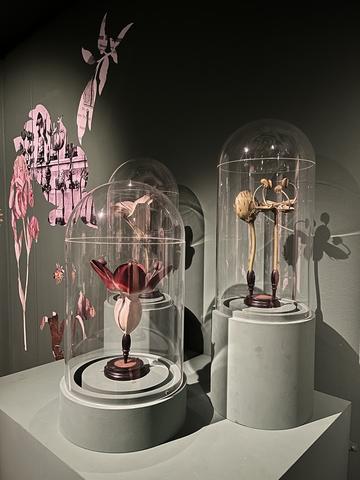
A selection of Robert Brendel (1821 – 1898) botanical teaching models on display at the Ashmolean
One of these exhibitions is the Ashmolean’s In Bloom – How plants changed our world, co-curated by Francesca Leoni and Shailen Bhandare. This major new exhibition takes visitors on a journey from Oxford to the farthest corners of the world and back, uncovering the global stories behind some of Britain’s most beloved blooms.
The exhibit contains loans from the Oxford Herbaria including a selection of Robert Brendel (1821–1898) botanical teaching models as well as various dried plant samples and botanical art.
Among the exhibition’s ‘Change Makers’ are several members of the Department of Biology, brought into focus through the work of photographer Fran Monks, best known for celebrating the remarkable individuals whose work quietly shapes the world around us. Their inclusion highlights how contemporary research, fieldwork, and historic collections continue to work together in tackling current global challenges.
Stephen Harris: The Duce curator of the Oxford University Herbaria and Associate Professor in Plant Sciences, Department of Biology. Stephen remarks that although it is modern technologies that offer innovative ways of using the herbaria to address old and new questions, it is the skills of the field-based collectors that determine the fundamental value of individual specimens. “A specimen that is poorly collected, prepared and labelled in the field will remain a poor specimen in the herbarium.”
Chris Thorogood: Deputy Director and Head of Science at the Oxford Botanic Gardens and Arboretum and Associate Professor of Biology, Department of Biology. Chris collaborates across disciplines, to learn from plants, looking at the technological application of biological adaptations. He says, “To me, this pitcher plant represents a living cosmos of possibilities…..My job is to help disclose them.”
Jane Langdale CBE FRS FAA: Professor of Plant Development, Department of Biology. Jane has led C4 Rice for the past 10 years, a project that aims to increase yields in one of the worlds top three staple crops. Jane says “It has been humbling to be part of a project that is cross-generational. Many of the original team have retired… It will be the next generation of researchers who take it over the line.”
To visit the exhibit please book here: IN BLOOM EXHIBITION | Ashmolean Museum
Refik Anadol: Archive Dreaming, The Schwarzman Centre for the Humanities, 25 April-6 June 2026
Archive dreaming is an immersive fusion of art and machine intelligence. This installation transforms a vast digital archive into a dynamic, dream-like experience, using AI algorithms to reimagine millions of documents in real time. The work uses Refik Anadol Studio's Large Nature Model, the first generative AI model dedicated entirely to nature, and reflects on how archives are no longer static repositories, but living entities that can be explored and visualised through technology.
Jules Hyun, Producer at Refik Anadol Studio worked with the Department of Biology and about one-fifth of the herbaria data to develop a navigation tool. The tool, based in the White Box in the brand new Schwarzman Centre, allows you to navigate what AI has understood of the archive.
The project points towards the growing potential of combining historic collections as well as contemporary datasets, with artificial intelligence in research. Opening-up new ways to identify patterns and explore large scientific datasets at a scale previously impossible.
The exhibit is open daily from 10:00-17:00 in the Schwarzman Centre, Oxford, White Box. No booking required. Refik Anadol: Archive Dreaming | Schwarzman Centre for the Humanities
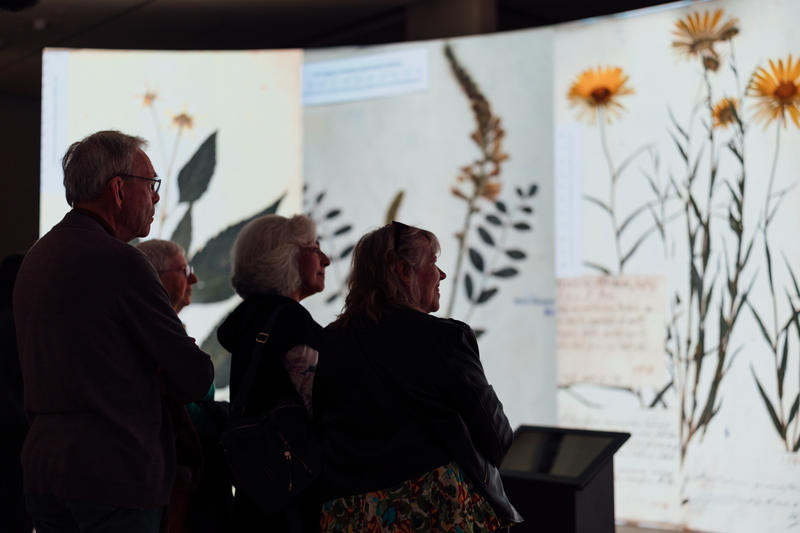
Oxford Atelier © Schwarzman Centre for the Humanities

Art@Saïd, Flourishing, Anthony Hopwood Gallery, Oxford Saïd Business School, 27 May to September 2026
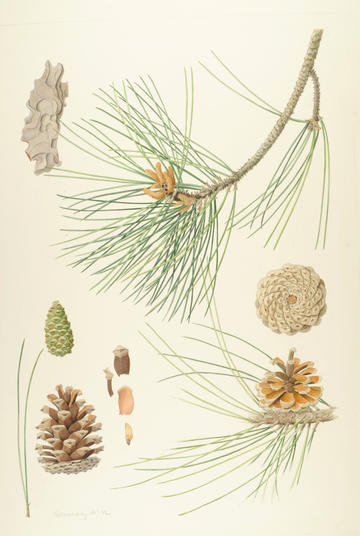
Flourishing explores the deep, often overlooked relationships between nature, people and society via a variety of art works. The exhibit contains artworks from Department of Biology members, Rosemary Wise and Chris Thorogood as well as artworks by other Florilegium botanical artists and landscape artist Julia Thaxton and finally poetry by Athol Williams, Senior Fellow of Management Practice in Strategy as well as Poet Laureate at Oxford Saïd Business School.
In collaboration with the Department of Biology, the exhibition highlights ecological connections with medicine, culture and sustainability, while also revealing the pressures plant species face in a rapidly changing world.
The Oxford Florilegium is a collaborative project led by Rosemary Wise, in which she unites artists in the creation of scientifically accurate botanical illustrations. They have spent the past 10 years documenting the living collections of the Oxford Botanical Gardens and Arboretum and over 100 illustrations have been accepted into the herbarium archive. Rosemary herself, whilst working as a botanical illustrator has produced detailed line drawings to support monographic works, floras, scientific papers and DPhil theses for the Department of Biology and its predecessors, since 1965 – more than 14,000 plant species. The opening event saw her tell us stories of her travels and ended with Athol dedicating his poem, Her Silent Gifts, to Rosemary.
Chris Thorogood’s works honour the collaborative network of researchers, foresters, scientists, and Indigenous stewards working to conserve a genus of parasitic flowering plants, Rafflesia. Among the most threatened plants, Rafflesia survive only where intact forests and local stewardship endure.
To book events associated with the exhibit see here: Flourishing | Saïd Business School
Rather than remaining behind closed doors, the herbaria is finding new ways to share its collections with the public. From historic specimens to AI-driven archives, the exhibitions highlight how the herbaria continues to support research, proving that collections remain essential tools for understanding a rapidly changing world.

