

Fungi found to be the crucial ingredient for restoring tropical islands
Oxford researchers have contributed to a new study which has demonstrated that symbiotic fungi play a crucial role in maintaining – and restoring – tropical island ecosystems. The findings offer new insight into how some of the world’s most biodiverse and fragile environments can recover from human disturbance.
The research focuses on the uninhabited Palmyra Atoll in the North Pacific, one of the most remote island systems on Earth. Its 42 low-lying islets support exceptionally intact coral reefs and one million seabirds, including vast colonies of sooty terns and red-footed boobies. However, the ecosystem has been heavily altered by human activity, including the introduction of invasive coconut palms in the 19th century and large-scale habitat modification during the Second World War.
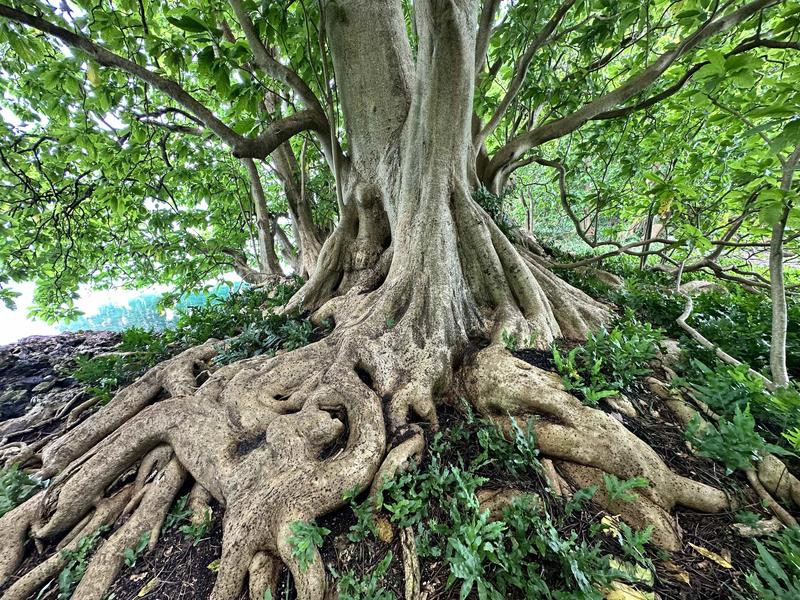
Image: Society for the Protection of Underground Networks
Today, Palmyra is co-managed by The Nature Conservancy (TNC) and the US Fish and Wildlife Service, which are leading major efforts to restore the islands’ native rainforest. Central to this work is the recovery of Pisonia grandis (‘the birdcatcher tree’): a native tree species favoured by nesting seabirds. These birds deliver large amounts of nutrients through their guano, supporting both forest growth and surrounding coral reef ecosystems. Huge areas of Pisonia trees were removed to make room for coconut palms, and many seedlings destroyed by invasive black rats (now eradicated). Reforesting the islands with Pisonia is thought to be the keystone for restoring this precious island ecosystem.
The new study suggests a crucial missing ingredient for reforestation: symbiotic fungi known as mycorrhizae. These fungi form networks around plant roots, helping trees access water and nutrients. They are also thought to play a key role in soil formation across Palmyra – slowly converting seabird guano and thin, sandy ground or coral rubble into a moist peat that enables trees to thrive. But up to now, the diversity of mycorrhizae across Palmyra and their importance in restoration was completely unknown.
Mapping hidden fungal networks
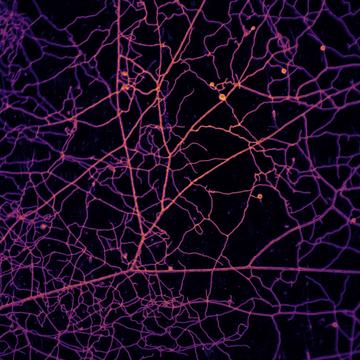
Microscopic image of network formed by the arbuscular mycorrhizal fungi, Rhizophagus irregularis
Image: Loreto Oyarte Gálvez - VU Amsterdam, AMOLF
In the first high-resolution survey of fungal diversity across Palmyra, an international team of researchers collected soil and root samples from 27 islets and analysed them using DNA sequencing techniques
The team identified 147 species of mycorrhizal fungi, with diversity varying according to plant communities and soil conditions. Comparisons with global databases suggest that some of these fungi may be rare or previously undescribed, including species from the genera Tomentella, Glomus, and Claroideoglomus thought to be found nowhere else.
A key finding was that Pisonia trees appear to depend on a remarkably specific fungal partner. Across 52 sampled trees, 100% of roots were associated with ectomycorrhizal fungi from the genus Tomentella, with one species (Tomentella pisoniae) present in almost every sample.
Study co-author Professor Stuart West said:
‘Most trees associate with many different mycorrhizal fungal partners. In contrast, we found that Pisonia relies almost entirely on a single species. This suggests an unusually tight and potentially fragile symbiotic relationship.’
Interestingly, the researchers also found evidence that these fungi have evolved to tolerate the extreme conditions created by a high concentration of seabird guano. Tomentella species associated with Pisonia were found in soils with very high phosphorus levels, indicating a specialised role in recycling nutrients and making them available to trees. In contrast, Tomentella species absent from Pisonia root samples were found only in soils with lower phosphorus levels.
‘We believe that fungi are the crucial link between the nesting seabirds and Pisonia,’ added Professor West. ‘By helping recycle the nitrogen, phosphorus and potassium in bird guano and making them available to the trees, they help transform poor, sandy soils into fertile ground that can sustain rainforest.’
Crabs as ecosystem engineers
The study also highlights the role of land crabs as ‘ecosystem engineers’. Palmyra is home to thousands of crabs of 12 different species, including the massive, tree-climbing coconut crab – one of the largest crabs on Earth. Samples taken from crab burrows contained significantly higher fungal diversity than surrounding soils, suggesting that the crabs’ burrowing activity helps mix and aerate the soil, and may aid the spread of fungal spores.
Professor West added: ‘The crabs add an extra level of interdependence. Crabs depend on the trees and the resources provided by the guano from the seabirds nesting in those trees, but they also appear to be helping spread the fungi that those trees need.’
Implications for restoration
The findings have important implications for ecosystem restoration. They suggest that reforestation efforts may fail if key microbial partners are missing, even when trees are replanted.
One potential solution is the use of ‘soil microbiome transplants’, where beneficial fungi are introduced alongside native seedlings. In future work, the researchers hope to directly test whether inoculating seedlings with Tomentella can boost their survival. Ultimately, Palmyra could provide a valuable test case for restoring atolls and island ecosystems more broadly.
Professor West added:
‘Our study has highlighted that conservation efforts cannot afford to consider only plants and animals but must also consider their microbial partners. As restoration efforts continue on Palmyra Atoll, understanding these complex interactions will be crucial for ensuring the long-term health and resilience of this unique ecosystem.’
The islands’ remoteness and unique ecosystem made for some challenging fieldwork conditions at times. For instance, the research team had to freeze their clothes each day to ensure they didn’t introduce any non-native plants and insects. But the unique environment more than made up for this.
‘It was an amazing opportunity to collect soil from Palmyra, one of the most remote locations in the world, a tropical shark-infested paradise that is literally screaming with thousands of seabirds,’ said Professor West. ‘We were even occasionally bumped by curious sharks as we waded through the lagoons.’
https://www.youtube.com/embed/7Ma6GBP1BDY?si=JG9k9FINpv1gfoU9
To read more about this research, published in Current Biology, visit: https://www.cell.com/current-biology/fulltext/S0960-9822(26)00435-5
The study involved researchers from Lund University, the Society for the Protection of Underground Networks (SPUN), The Nature Conservancy, Vrije Universiteit Amsterdam, Outer Coast College, Stanford University, American University, and University of Hawai’i at Manoa
For more information about this story or republishing this content, please contact news.office@admin.ox.ac.uk

